
How to Know if Your Mentoring Program is Actually Working
64% of organizations now run mentoring programs, up from 33% just 5 years ago, but many struggle to know if they're actually working. (HR.com)
If you run L&D or People Ops in a small or mid-sized business, you know mentoring should help people grow skills, confidence, and career momentum. But without a simple way to check if relationships are actually healthy, you're left guessing which pairs are thriving and which are quietly stalling.
This article shows you how to measure mentoring relationship quality, the leading indicator that tells you if your program has the conditions to deliver real results. We'll walk through the Mentoring Pair Quality Index (PairQI), its five key domains, and practical ways to put it to work without a big HR team or fancy tech stack.
Read on to take your mentoring program from "hope it works" to "we can see it's working."
The Importance of Evaluating Your Mentoring Program
Mentoring programs are powerful tools for professional development, offering guidance, support, and invaluable insights. However, without proper evaluation, it’s easy to drift into the realm of assumption, believing that the mentoring practices in place are effective simply because they exist.
Most organizations track mentoring indirectly: promotions, performance ratings, retention. Those are important, but they’re slow. You might not see the impact of mentoring for 12–24 months.
What you need alongside those metrics is a leading indicator, a way to tell if a mentoring relationship has the conditions to produce growth right now.
Research on youth and workplace mentoring keeps pointing to the same idea: when mentoring works, it’s usually because the quality of the relationship is high, not because the program is flashy. (Mentoring.org; National Mentoring Resource Center)
High-quality relationships tend to share some common ingredients (NMRC Measurement Guidance Toolkit):
Trust and emotional safety.
Clear expectations and goals.
Useful, specific feedback and support.
A sense of fit, respect, and belonging.
Consistent time together with some structure.
When those elements are present, studies have linked mentoring to better social and emotional skills, stronger goal-directed behavior, and improved school or work outcomes.
The good news: you don’t need to build a research lab to measure these things. You just need a simple, consistent way to ask mentees about their experience.
Meet PairQI: a simple way to measure mentoring relationship quality
The Mentoring Pair Quality Index (PairQI) is our simple measurement for something research has been circling for years: a short set of questions that captures how strong a mentoring relationship is, from the mentee’s perspective.
Here’s how PairQI works at a high level:
You ask mentees to rate a handful of statements about their mentoring relationship.
They respond on a 1–5 scale (from strongly disagree to strongly agree).
You group those questions into a few key areas (called “domains”) that reflect what research says matters. (Mentoring.org; National Mentoring Resource Center)
You average the scores to get:
A score for each domain.
One overall “Mentoring Pair Quality Index” or PairQI score for that relationship.
It’s not meant to be perfect; it’s meant to be practical. A PairQI should be:
Short enough to complete in 5–10 minutes.
Clear enough that non-HR leaders can understand the results at a glance.
Simple enough that you can calculate scores in a spreadsheet.
Think of PairQI as a “vital signs” check for your mentoring program.
The five domains that make up PairQI
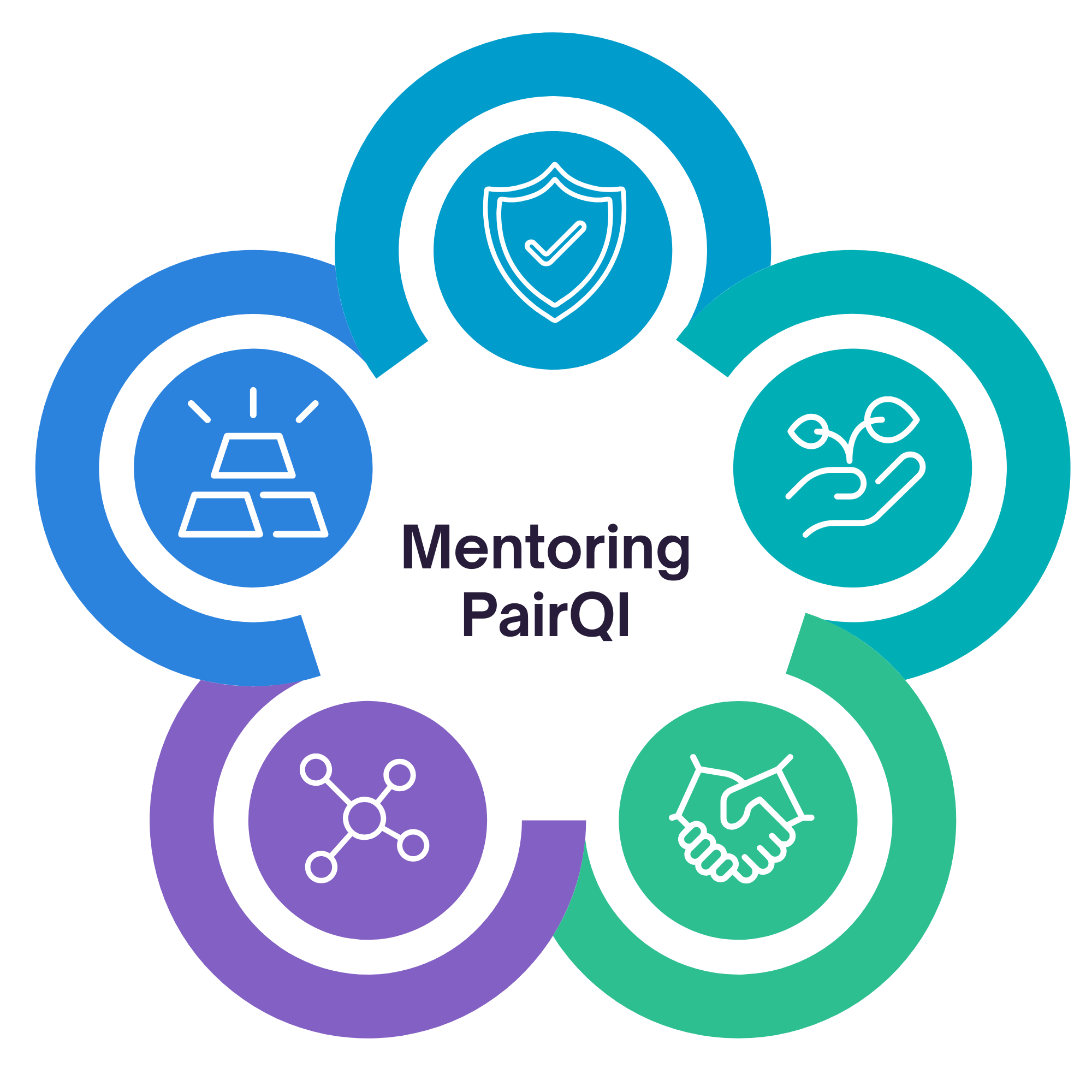
Pair Quality Index
Different studies use different labels, but they tend to come back to similar themes. We’ve translated those themes into five domains that make sense in a mentoring program context.
1. Trust & Psychological Safety
Relationship-quality research routinely highlights trust, closeness, and safety as core ingredients of effective mentoring. In this domain, we want to know if mentees feel safe to be honest and imperfect.
This includes questions like:
Can they talk about real work challenges, not just the safe ones?
Can they say, “I don’t know” or “I messed up” without worrying it will come back to bite them?
Do they trust their mentor to keep sensitive information confidential?
2. Career Growth & Goals
Studies show that mentoring relationships with clear goals and a developmental focus tend to have stronger effects on outcomes like skills, confidence, and persistence.
Here you’re looking for things like:
Have they agreed on what the mentee wants to get out of mentoring?
Do conversations link to real work and future roles?
Do they check in on progress from time to time?
3. Feedback & Autonomy
Research on mentoring and coaching alike suggests that feedback, modeling, and guided problem-solving are key mechanisms for growth. Here we want to understand how the mentor relationship translates into growth in the skills and confidence of mentees.
This is where coaching behavior shows up:
Does the mentor give specific, actionable feedback?
Do they help the mentee think through decisions, instead of just handing down answers?
Do they encourage the mentee to try things, decide, and learn?
4. Relational Fit
Work from the National Mentoring Resource Center and others has linked emotionally engaging, inclusive relationships to better social-emotional outcomes and stronger engagement. We want to ensure that mentees feel respected, understood, and like they belong within the mentoring relationship.
Here we’re interested in:
Mutual respect and workable interpersonal fit.
Whether the mentor is curious about the mentee’s background and experience.
Whether the relationship helps the mentee feel more connected to the organization.
5. Structure & Early Impact
Program evaluations frequently find that match structure and perceived program support are tied to stronger relationship quality and outcomes.
For example:
Do they meet regularly enough to build momentum?
Do their meetings have some structure (even a simple agenda)?
Is the mentee already noticing value such as more confidence, clarity, or willingness to take on stretch work?
Why bother with PairQI at all?
You might be wondering: “Can’t we just ask people if they like their mentor?”
You can, but you’ll miss a lot. An index like PairQI helps you:
See nuance. A mentee might like their mentor (high trust) but get very little concrete feedback (low developmental support).
Know where to act. If most relationships score low on structure, you know to tighten expectations around meeting frequency and agendas.
Track change over time. You can see if this year’s mentoring cohort is healthier than last year’s.
Connect to business outcomes. Over time, you can compare MQI scores with things like retention, performance, or readiness for promotion.
Other fields have used similar quality indicators to guide improvement. For example, the “Mentoring Relationship Quality Scale” in youth programs and quality-of-instruction frameworks in education. PairQI applies the same idea to your day-to-day mentoring program.
How to start evaluating your mentoring program (without overcomplicating it)
Here's how to put PairQI to work in your program with four simple steps.
Step 1: Start with the five domains we've outlined above.
These aren't arbitrary. They're the conditions that research consistently show matter most for mentoring that actually moves the needle.
Write a few straightforward questions for each one.
"I can discuss real work challenges with my mentor."
"My mentor and I have clear goals for what I want to develop."
"I leave our meetings with concrete ideas I can use at work."
Ask mentees to rate each on a simple 1-5 scale: Strongly disagree (1) to Strongly agree (5). That's it.
Step 2: Pick three moments to check in.
We've found 6-8 weeks into the relationship works well, that's when rapport is forming but patterns are clear. Then midpoint and end-of-program (or once a year for ongoing pairs). Three touchpoints give you enough data without overwhelming anyone.
Step 3: Keep the math simple.
For each domain, average the answers to get a domain score (say, 3.8 out of 5 for Psychological Safety). Then average all the scores together for one overall PairQI score per relationship. Done.
Step 4: Now look for the story in the patterns.
Now you have the numbers, so make meaning of them. Start by asking:
Where is this relationship strong? (Maybe great trust, but low structure)
Where is it vulnerable? (Low developmental support across the cohort?)
What would actually help? (Mentor training on feedback? A simple meeting agenda template? A conversation about goals?)
That's when MQI becomes more than a score; it becomes a diagnostic tool that tells you exactly where to focus your limited time and energy.
If you'd like a full question set, scoring thresholds, and domain-by-domain action guide ready to go, read on about our free MQI Guide.
Want help? Grab the Free PairQI Guide
If you want help putting PairQI into practice, we’ve put together a free 13-page guide that walks you through how to actually use it:
A sample of adaptable survey questions you can use to gather feedback from mentees.
Simple instructions for scoring responses and making sense of the results.
Examples of how to interpret patterns in the data and decide where to step in or adjust your approach.
And if you want to go one step further, our Mentoring PairQI Kit includes a plug-and-play spreadsheet that calculates PairQI for you, plus a pre-populated survey to collect the responses for the PairQI so you can start and evaluate your mentoring program in a matter of days, not months.
Common Mistakes to Avoid
While evaluating your mentoring program, there are pitfalls to steer clear of:
Neglecting to Follow Up After Feedback: Collecting feedback permits you to engage participants, but failing to respond will cause disinterest.
Focusing Solely on Numbers: While metrics are important, the personal experiences and qualitative data are equally important in shaping a well-rounded view of program impact.
Being Inflexible: Changes based on feedback may require you to re-evaluate your existing structure and be open to experimenting with new formats.
Final Thoughts on Program Evaluation
Evaluating the effectiveness of your mentoring program is not just a check-box activity; it is an essential part of ensuring you are creating impactful, connection-centered learning experiences. Through continuous monitoring and adjustment, you support not just the growth of your participants but also the overall objectives of your organization.
Remember, the key to successful mentoring is regular assessment and readiness to adapt. Your program should grow as your participants do, continually fostering a culture of connection and growth.
More on the Research
We're committed to sharing practical tools and insights grounded in solid research, without the jargon.
PairQI draws from established mentoring research, including work from Mentoring.org on relationship quality and the National Mentoring Resource Center's measurement toolkit. Both are excellent resources if you want to dig deeper into the evidence behind effective mentoring evaluation.
Statement on AI Use
We use AI to research faster so we can focus on what matters, practical tools that actually work for you. This article was researched and written with AI assistance under human direction. Loam's framework and voice are our own, shaped by years of working directly with L&D teams. We verify and link to every claim and adapt every idea to fit real-world needs.
